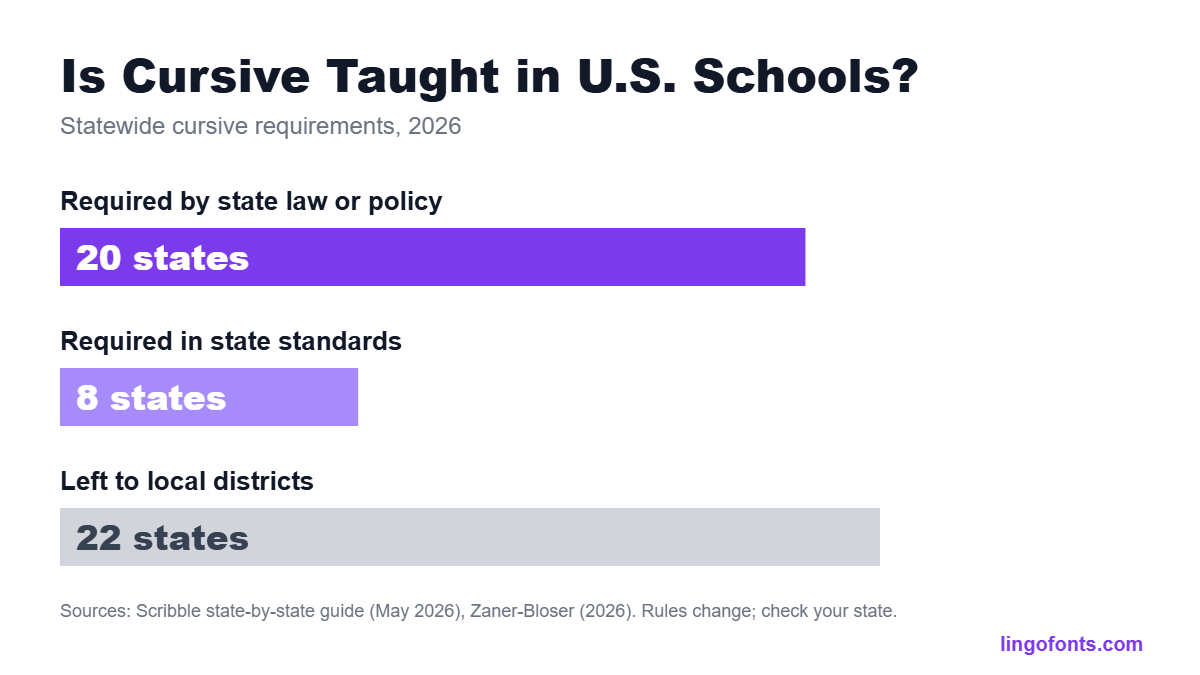
Is cursive taught in schools? It depends on your state. As of 2026, about 28 U.S. states require or explicitly expect cursive handwriting instruction, either by state law or through state learning standards. In the remaining states, each school district decides. So whether your child learns cursive is now mostly a question of where you live.
Cursive almost disappeared from American classrooms after 2010, and it is now one of the fastest-returning subjects in elementary education. This guide shows which states require it in 2026, why schools dropped it, why lawmakers are bringing it back, what grade kids usually start, and what parents can do if their school doesn’t teach it.
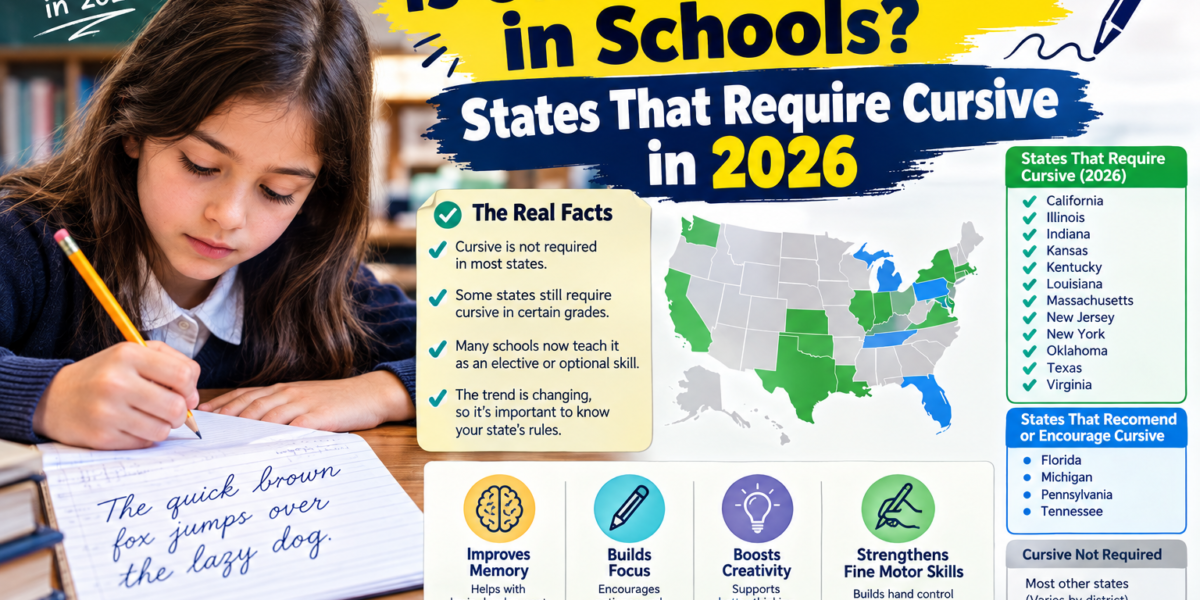
States That Require Cursive in 2026
Is cursive taught in schools everywhere in the U.S.? No. There is no federal law, so it’s decided state by state. The lists below follow the state-by-state guide published by Scribble (updated May 2026), cross-checked against Zaner-Bloser’s 2026 handwriting law summary. Laws change every legislative session, so check your state department of education for the current rule.
Required by state law or statewide policy (20 states)
| State | What the requirement says |
|---|---|
| Alabama, Arkansas, Louisiana, Mississippi, North Carolina, Oklahoma, South Carolina, West Virginia | Required by state law or statewide policy |
| Arizona | Cursive reading and writing are part of the required course of study |
| California | Cursive or joined italics in grades 1–6 (AB 446, signed 2023) |
| Delaware | Every public elementary school teaches cursive by the end of grade 4 |
| Idaho | Cursive starts by grade 3, with continued support through grade 5 |
| Illinois | Cursive taught in elementary grades |
| Kentucky | Cursive taught before the end of grade 5 |
| Maryland | Instruction leading to legible cursive by the end of grade 5 |
| New Hampshire | Cursive required by state law |
| New Jersey | Cursive in grades 3–5, starting with the 2026–27 school year |
| Ohio | Both print (manuscript) and cursive instruction |
| Pennsylvania | Cursive in the writing curriculum (Act 2 of 2026), public and private schools |
| Tennessee | Cursive required by state law |
Required through state learning standards (8 states)
- Florida, Iowa, Texas, Virginia: cursive is part of the state’s elementary English language arts standards.
- Georgia: standards include reading and writing cursive in grades 3–5.
- Utah: grade 3 standards expect upper- and lowercase cursive, continuing in grade 4.
- Kansas: handwriting standards expect legible cursive and the ability to read it.
- Massachusetts: standards expect legible, fluent handwriting in print or cursive, so cursive itself isn’t guaranteed.
Left to local school districts (22 states)
Alaska, Colorado, Connecticut, Hawaii, Indiana, Maine, Michigan, Minnesota, Missouri, Montana, Nebraska, Nevada, New Mexico, New York, North Dakota, Oregon, Rhode Island, South Dakota, Vermont, Washington, Wisconsin and Wyoming have no statewide cursive mandate in effect, though many districts in these states still teach it. Indiana’s law allows schools to teach cursive without requiring it. Cursive bills have been introduced in New York and Missouri, and a 2025–26 bill in Maine (LD 78) failed in the state Senate.
Why lists don’t match: trackers count the states that require cursive differently. Some include only laws; others count standards. Missouri is a good example: Zaner-Bloser lists cursive benchmarks in Missouri’s 2016 learning standards, while other trackers find no binding statewide requirement. The trend is clear either way: cursive tracking site MyCursive counted 14 states in 2016 and 20 in 2019, LiveNOW from FOX reported at least 27 in 2024, and two more large states (New Jersey and Pennsylvania) passed laws in 2025–26.
When Did Schools Stop Teaching Cursive?
The decline started in 2010, when most states adopted the Common Core State Standards for English language arts. Common Core included keyboarding but did not include cursive, so many districts dropped it to make room for typing, testing prep and other subjects. Schools didn’t ban cursive; it simply stopped being required, and with limited classroom time, optional subjects tend to disappear.

That is why the answer to “is cursive taught in schools?” changed so quickly, and why many Americans born in the late 2000s and 2010s were never formally taught cursive, while their parents and grandparents learned it in second or third grade.
Why Is Cursive Coming Back?
Ask parents and lawmakers “is cursive taught in schools again?” and in a growing number of states the answer is yes. These are the three reasons they give most often.
1. Reading historical documents
Founding documents, family letters, old census records and military records are handwritten in cursive. In 2025, NPR reported that the U.S. National Archives was recruiting volunteers who can read cursive to help transcribe records through its Citizen Archivist program, because so many historical documents are unreadable to people who never learned it. Several state lawmakers have cited exactly this reason.
2. Handwriting and the brain
A 2024 study in Frontiers in Psychology by researchers at the Norwegian University of Science and Technology found that college students writing words in cursive with a digital pen showed much more widespread brain connectivity than when they typed the same words, in patterns linked to memory. Worth knowing before you quote it: the study measured brain activity, not test scores, and compared handwriting with typing rather than cursive with print. As Science News noted, outside researchers called for follow-up work.
3. Signatures and everyday life
Signing your name, reading a handwritten birthday card from grandparents, or understanding a teacher’s comments on a paper are practical reasons parents often give. Supporters also point out that joined letters can be faster to write by hand than print once a student is fluent.
The case against
Critics argue that classroom minutes are limited and are better spent on typing, reading and math, and that a legible print signature is legally just as valid as a cursive one. That debate is why requirements vary so much from state to state.
What Grade Do Kids Learn Cursive?
Most U.S. programs introduce cursive in second or third grade, after children can print comfortably, and expect fluency by the end of fourth or fifth grade. State requirements reflect that window:
- California: grades 1–6
- Idaho: by grade 3
- Georgia and New Jersey: grades 3–5
- Delaware: by the end of grade 4
- Kentucky and Maryland: by the end of grade 5


LingoFonts TeamAdminEdit Profile
Is Cursive Taught in Schools Near You? How to Check
- Search your state department of education site for “handwriting” or “cursive” plus “standards.”
- Ask your child’s school which handwriting program it uses and in which grade cursive starts.
- If your state has no mandate, ask the district: many still teach cursive locally even without a law.
- Private, parochial, charter and homeschool programs set their own curriculum and may teach cursive regardless of state rules.
What Parents Can Do If School Doesn’t Teach Cursive
If the answer to “is cursive taught in schools?” is no where you live, don’t worry: cursive is easy to learn at home in short sessions. A few approaches that work well:
- Keep it short: 10 minutes a day beats an hour on Saturday.
- Start with lowercase letters, grouped by the strokes they share, before moving to capitals.
- Teach reading too: let kids read a real handwritten letter or recipe card, which is often the most motivating part.
- Write meaningful words first: their own name, a pet’s name, a thank-you note.
- Use the full alphabet as a model: our cursive writing guide covers the cursive alphabet, letter styles and practice tips.
Want to show a child how a word looks in cursive before they write it? Type it into the free cursive generator and download a clear PNG to print and trace. The 32 script fonts give you several “teacher-style” models to compare, and the copy-and-paste Unicode styles work in a document or a message. One honest note: a cursive writing generator shows the shapes, but only practice with a pencil builds the skill.
If your child is curious about fancier lettering after learning cursive, cursive vs. calligraphy explains how the two differ.
Frequently Asked Questions
Is cursive taught in schools anymore?
Yes, in many places. About 28 states require or explicitly expect cursive through law or state standards as of 2026, and many districts in the other states still teach it locally.
What states require cursive?
Required by law or statewide policy: Alabama, Arizona, Arkansas, California, Delaware, Idaho, Illinois, Kentucky, Louisiana, Maryland, Mississippi, New Hampshire, New Jersey, North Carolina, Ohio, Oklahoma, Pennsylvania, South Carolina, Tennessee and West Virginia. Florida, Georgia, Iowa, Kansas, Massachusetts, Texas, Utah and Virginia include it in state standards.
When did schools stop teaching cursive?
Mostly after 2010, when the Common Core State Standards were adopted. They included keyboarding but not cursive, so many districts stopped teaching it.
Does Common Core require cursive?
No. The Common Core English language arts standards do not include cursive, which is why many states added their own cursive laws or standards.
What grade do kids learn cursive?
Usually second or third grade, with fluency expected by the end of fourth or fifth grade. Requirements range from grades 1–6 in California to grades 3–5 in Georgia and New Jersey.
Is a cursive signature legally required?
No. A signature can be printed or written in any style, as long as it’s how you consistently sign.