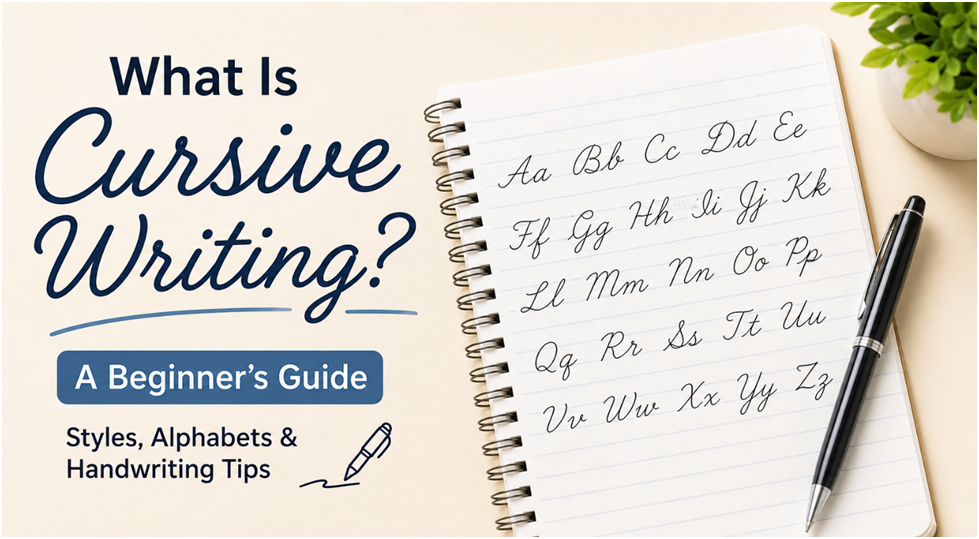
What Is Cursive Writing?
Cursive writing is a handwriting style where letters are written in a smooth, connected flow instead of being separated. This continuous stroke allows the pen to move naturally across words, making writing faster and more elegant. Unlike printed text, cursive creates a linked structure that improves rhythm, speed, and personal expression in handwriting. Cursive is often confused with calligraphy, but they are not the same thing — see our cursive vs. calligraphy comparison for the real difference.
Even in today’s digital era, cursive writing remains important in education, design, and historical studies. Students and beginners also use online tools like a cursive generator to understand how letters connect and how different handwriting styles look in real time. These tools simplify learning and make practice more interactive and visual.
Importance of Cursive Writing in Modern Learning
Cursive writing is more than just a beautiful handwriting style—it supports cognitive development. When learners practice cursive, they improve hand coordination, memory retention, and writing fluency. Writing continuously without lifting the pen trains the brain to process language more efficiently.
Cursive is also essential for reading historical documents, personal letters, and older academic materials. Many such records are written in cursive, making it a valuable skill for researchers and students.
Today, learners combine traditional practice with digital tools like cursive alphabets charts and interactive writing apps. These help beginners build a strong foundation before moving to advanced writing styles. Visit the home page to use the Cursive Generator.
Different Types of Cursive Writing Styles Worldwide
Cursive writing is not universal—it varies across languages and regions. Each style reflects cultural and linguistic differences.
American Cursive Style
American cursive is smooth, rounded, and widely taught in schools. It focuses on readability and speed. Many students practice it using an American cursive generator.
Russian and Bulgarian Cursive Styles
Russian and Bulgarian cursive are faster and more complex. They include sharp connections and unique letter shapes. Tools like a russian cursive generator and bulgarian cursive generator help learners understand these advanced scripts.
Armenian Cursive Style
Armenian handwriting has a distinct flowing structure that reflects its cultural heritage. An Armenian cursive generator helps learners explore its elegant script formation.
These variations show how cursive adapts to different languages while maintaining its core principle of connected writing.
Cursive Writing in Asian Languages
Asian writing systems also include cursive-like styles. In Chinese calligraphy, cursive is known as “grass script,” where characters are simplified into fast, fluid strokes. A Chinese cursive generator helps learners visualize this artistic transformation.
Japanese writing includes cursive-inspired forms like “sōsho,” which focuses on smooth brush movement and speed. Many learners explore cursive Japanese styles to understand how traditional characters become more fluid and expressive.
These systems prove that cursive is a global concept, not limited to the English alphabet.
Role of Cursive Generators in Modern Learning
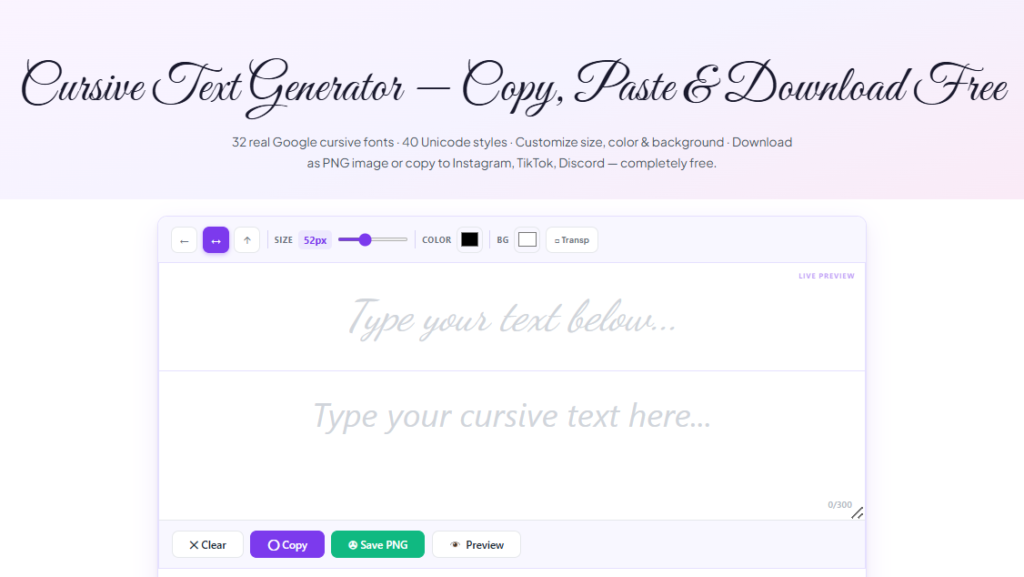
Technology has made learning cursive easier through digital tools. A cursive generator converts normal text into cursive instantly, helping users understand letter flow without manual practice. Many cursive genrators are available in market like TheWordFinder.
Different specialized tools exist for various writing systems:
- Russian cursive generator for Cyrillic handwriting practice
- American cursive generator for English school-style cursive
- Armenian cursive generator for Armenian script learning
- Bulgarian cursive generator for Eastern European styles
- Chinese cursive generator for artistic character writing
- Different types of cursive generator platforms for multiple style comparison
These tools are especially helpful for beginners because they provide instant visual learning and reduce confusion in letter connections.
Benefits of Learning Cursive Writing
Cursive writing offers several educational and cognitive benefits. It improves fine motor skills, enhances concentration, and strengthens memory. Writing continuously also increases speed and helps learners develop better focus compared to typing.
It also improves creativity, as handwriting allows more personal expression. Many people find cursive more artistic and meaningful than printed text.
Using tools like cursive alphabets guides and a cursive generator can make practice easier and more engaging for beginners.
How to Learn Cursive Writing Effectively
The best way to learn cursive is through consistent practice. Start with lowercase cursive alphabets, focusing on smooth connections rather than speed. Once comfortable, move to uppercase letters.
Next, practice forming simple words, then short sentences. Repetition helps build muscle memory, which is essential for fluent writing.
Digital tools like different types of cursive generator platforms can also help learners compare styles and practice visually before writing on paper.
Conclusion
Cursive writing remains a valuable skill in both education and personal development. It improves handwriting speed, enhances cognitive ability, and preserves traditional writing skills in a digital world. With the help of modern tools like the cursive generator, learners can explore global styles such as the Russian cursive generator, the American cursive generator, and the Chinese cursive generator with ease.
By mastering cursive alphabets and practicing regularly, anyone can develop smooth, elegant, and confident handwriting.
FAQs
1. What is cursive writing?
Cursive writing is a style where letters are connected in a flowing manner for faster and smoother handwriting.
2. Why is cursive writing important?
It improves memory, writing speed, focus, and helps in reading historical documents.
3. What is a cursive generator?
It is an online tool that converts normal text into cursive style for learning and design.
4. Are there different types of cursive writing?
Yes, including American, Russian, Bulgarian, Armenian, Chinese cursive, and Japanese cursive styles.
5. Can beginners learn cursive easily?
Yes, with practice and tools like cursive generators and alphabet guides, beginners can learn quickly.