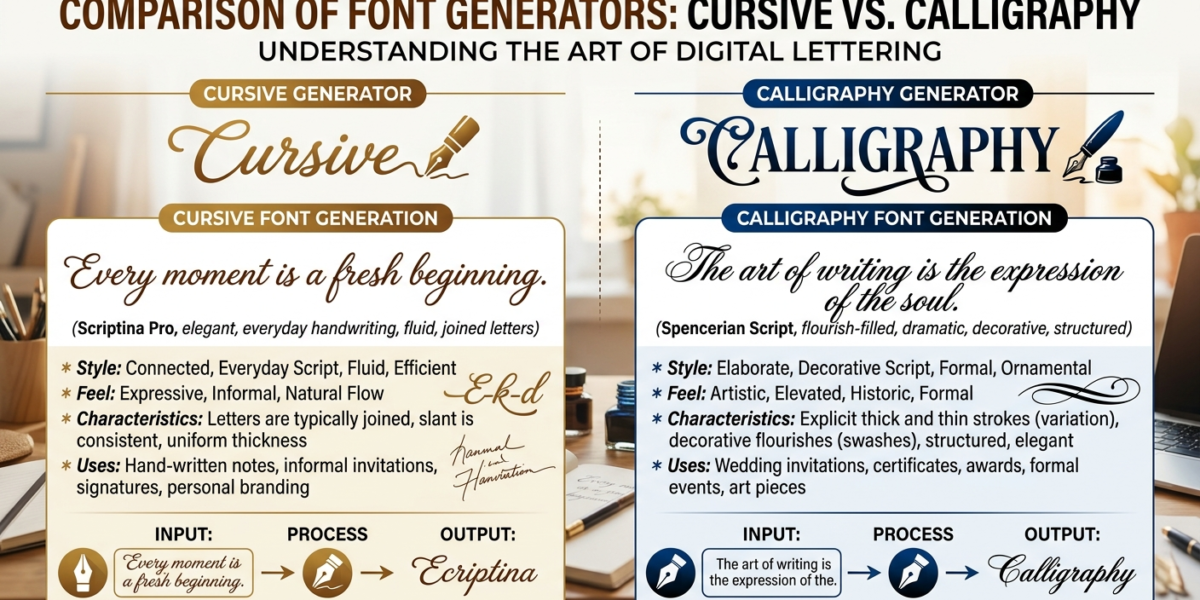
Is calligraphy the same as cursive? No. The two words get used interchangeably all the time, but they mean different things. Cursive is a handwriting style built for speed — the letters connect so your pen never leaves the page. Calligraphy is an art form built for beauty — a broader discipline that uses specific tools and deliberate technique to make letters visually striking, and it isn’t limited to any one script.
Put simply: cursive is a script. Calligraphy is a craft that can be applied to many scripts — including cursive ones.
If you’ve ever typed “calligraphy vs cursive” (or the other way round) into a search bar trying to figure out which one you actually need, you’re not alone — the confusion is common, and the answer matters more than it seems.
Cursive vs. Calligraphy: The Short Answer
| Cursive | Calligraphy | |
|---|---|---|
| Purpose | Write faster | Make writing beautiful |
| Tools | Any pen or pencil | Broad-nib pens, brush pens, dip pens |
| Where you learn it | Grade school handwriting class | As a craft, hobby, or trade skill |
| Structure | One fairly fixed alphabet per language | Many distinct styles (Copperplate, Gothic, Modern, Italic, and more) |
| Typical use today | Signatures, quick notes | Wedding invitations, certificates, branding, art |
What is cursive, exactly?
Cursive is a style of handwriting where letters within a word are joined together in one continuous stroke, instead of being lifted and placed separately like print. It was developed for practical reasons — connected letters are faster to write and, historically, faster to teach at scale in classrooms.
Every language with a Latin-based alphabet has its own standard cursive form (and non-Latin scripts have their own joined-writing conventions too — Arabic, for instance, is inherently connected by design). Cursive generally has a fixed, standardized letterform: there’s a cursive lowercase “e,” not dozens of artistic variations of it.
What is calligraphy, exactly?
Calligraphy literally means “beautiful writing” (from the Greek kallos, beauty, and graphein, to write). It’s not a single script — it’s a discipline. A calligrapher deliberately controls stroke width, spacing, and rhythm, typically using a tool built for the job: a broad-edge nib, a pointed pen, or a brush pen, all of which create thick-and-thin line variation that an ordinary pen can’t.
Because calligraphy is a technique rather than one alphabet, it spans many distinct styles: Copperplate, Spencerian, Gothic (Blackletter), Italic, and the loose, modern “brush lettering” style popular on Instagram and in wedding stationery today.
Wait — so can cursive be calligraphy?
This is where the confusion usually comes from, and the honest answer is: sometimes, yes. Historic scripts like Copperplate and Spencerian are calligraphic styles built directly on cursive’s connected, flowing movement — they’re cursive vs calligraphy at the same time. That’s the overlap. But plain, everyday cursive handwriting — the kind taught in elementary school — isn’t calligraphy, because it isn’t optimized for visual beauty; it’s optimized for speed.
Think of it this way: all Copperplate is cursive-based, but not all cursive is Copperplate.
A short history of each
Cursive grew out of the need to write fast. Joined letters let a writer keep the pen on the page, which mattered when everything from letters to ledgers was handwritten. In the United States, cursive teaching was shaped by a few named systems: the Spencerian script of Platt Rogers Spencer in the mid-1800s, the simpler Palmer Method that Austin Palmer promoted from the 1890s, and later Zaner-Bloser and D’Nealian, which Donald Thurber introduced in 1978 to ease the step from print to cursive.
Calligraphy is much older and was never mainly about speed. Chinese and Arabic calligraphy have been treated as fine arts for well over a thousand years. In Europe, scribes developed hands such as Carolingian minuscule, promoted under Charlemagne around 800 AD, and the dense Gothic blackletter of the later Middle Ages. In the 1700s English roundhand, often called Copperplate after the engraved plates used to print copybooks, became the model for elegant formal writing.
That difference in origin explains a lot: cursive was designed to be practical for everyone, while calligraphy was designed to be beautiful, even when that made it slow.
The tools: what you actually need
- Cursive: any pen or pencil. The line weight stays the same, because the shapes come from how the letters connect, not from the tool.
- Broad-edge calligraphy (italic, blackletter, uncial): a chisel-tipped nib or marker held at a fixed angle. The thick and thin strokes appear automatically as the pen changes direction.
- Pointed-pen calligraphy (Copperplate, Spencerian): a flexible pointed nib. Thick strokes come from pressing on the downstroke, and thin strokes from a light upstroke.
- Brush lettering: a brush pen with a flexible tip, using the same pressure principle. This is the most common starting point for modern hand lettering.
No special tools? Try “faux calligraphy”: write a word in normal cursive with an ordinary pen, then go back and thicken every downstroke by drawing a second line beside it and filling the gap. It is a good way to train your eye for where the weight belongs before you buy any nibs.
What about digital text?
On a screen, neither cursive nor calligraphy is something you can paste as a real font. The “script” letters you can copy and paste, like 𝒞𝓊𝓇𝓈𝒾𝓋ℯ, are Unicode characters from the Mathematical Alphanumeric Symbols block. They imitate a joined, flowing style, but the letters never actually connect, and they cannot vary their stroke weight the way pen calligraphy does. For true calligraphic effects in a design or invitation, you need an installed calligraphy typeface in a design app. For social bios and captions, Unicode script styles are the practical option.
Calligraphy vs Cursive: Which One Should You Use?
- Reaching for cursive: signatures, personal notes, anything where speed matters more than polish, or general script-style text for a bio or caption.
- Reaching for calligraphy: wedding invitations, certificates, logos, branding, or anywhere the letterforms themselves need to carry visual weight.
Try both, free
You don’t need a fountain pen or years of practice to get either look for digital use. Both tools below generate real, ready-to-copy text — no signup:
- Cursive Generator — for names, bios, and quick script-style text
- Calligraphy Font Generator — for elegant, hand-lettered-style text for invitations and branding
Planning invitations or place cards? Our guide to calligraphy fonts for wedding invitations covers which styles stay readable in print, and What Is Cursive Writing? goes deeper into the handwriting side.
Want to see every calligraphy letter side by side? Browse the full calligraphy alphabet in six copy-and-paste styles.
FAQ
Is cursive a font?
Not exactly. Cursive is a handwriting style — when you see “cursive fonts” online, those are digital typefaces designed to imitate that connected, flowing look.
Is calligraphy the same as handwriting?
No. Handwriting is whatever comes naturally when you write by hand. Calligraphy is a deliberate, trained craft using specific tools to produce a controlled visual effect.
Can I learn calligraphy if my handwriting is bad?
Yes — they’re not related skills. Calligraphy is about controlling a tool with consistent pressure and angle, not about how neat your everyday handwriting is.
What’s the easiest calligraphy style for a beginner?
Modern calligraphy (the loose, brush-pen style common in wedding stationery) is generally considered the most forgiving starting point, since it doesn’t demand the strict letterform rules that Copperplate or Gothic do.
The Bottom Line
Cursive vs calligraphy isn’t really a competition — they solve different problems. Cursive exists so you can write faster; calligraphy exists so writing can be beautiful. One is a script you learned in school and use without thinking. The other is a craft you deliberately practice with the right tools.
The overlap is real — historic styles like Copperplate prove cursive movement and calligraphic artistry aren’t mutually exclusive — but for everyday purposes, the distinction holds: if you’re signing your name or jotting a quick note, that’s cursive. If you’re addressing a wedding invitation or designing a logo that needs to feel handcrafted, that’s calligraphy.
You don’t have to choose just one, either. Try both free, no signup required: the Cursive Generator for fast, flowing script text, and the Calligraphy Font Generator for elegant, hand-lettered styles — and see which one actually fits what you’re making.