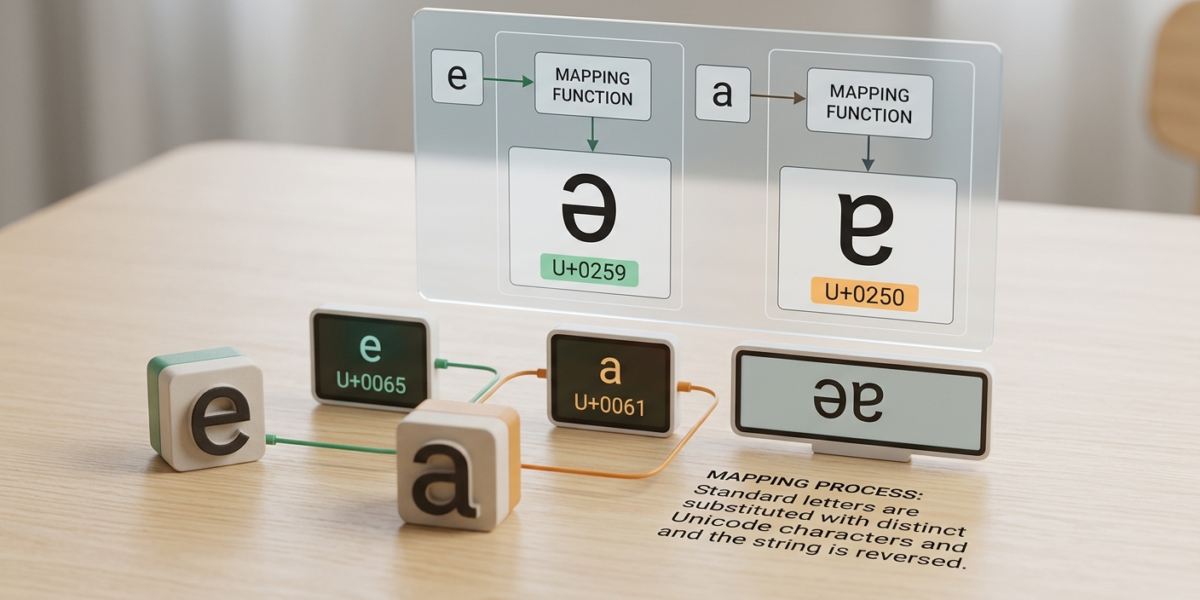
If you’ve ever seen “ǝʞᴉl sᴉɥʇ” text on Instagram or TikTok and wondered how it’s done, the answer surprises most people: there’s no Upside down text. What looks like flipped text is actually a clever substitution trick using existing Unicode characters — the same universal character system every website, app, and phone already understands.
The short answer
Every letter in the alphabet gets swapped for a different character that happens to look like it flipped 180°. The letter order also gets reversed. Put those two steps together, and a normal sentence reads correctly when the whole line is turned upside down.
That’s why “hello” becomes “oʅʅǝɥ” — not because “hello” was rotated as an image, but because each letter was individually replaced and the whole string was reversed.
Why this works everywhere (Instagram, Discord, TikTok, WhatsApp)
Because upside down text is just standard Unicode — not an image, not a custom font, not a special app feature — it pastes correctly into literally any text field that accepts normal characters. That’s the entire trick: your phone, Instagram’s caption box, and Discord’s chat window are all just displaying Unicode text. If a character exists in the Unicode standard, it displays, full stop.
This is also why it survives being copied and re-pasted between completely different apps and operating systems, unlike an image or a font file, which would need to be installed or attached separately.
Why some letters look better flipped than others
Here’s the part most upside-down text generators don’t explain honestly: Unicode doesn’t include a “flipped” version of every letter. For letters like “n” (which becomes “u”) or “e” (which becomes “ǝ”), there’s a genuinely close visual match. But for a handful of letters — particularly ones with no naturally symmetrical or invertible shape — the available Unicode character is only an approximation, not a perfect mirror image.
This isn’t a bug in any particular generator; it’s a real constraint of the Unicode standard itself, which was never designed with “upside-down text” as a use case. Any generator claiming 100% pixel-perfect flipping for every character is glossing over this.
Common uses
- Social bios and captions — a quick way to make an Instagram or TikTok bio stand out
- Discord nicknames and messages — a lightweight way to differentiate a username
- Novelty texts and messages — WhatsApp, Facebook, or group chats
- Testing platform text handling — developers sometimes use it to check how apps render unusual Unicode input
Upside down vs. reverse text: what’s the difference?
These two get confused constantly. Upside down text flips each letter’s shape and reverses the order — it’s meant to look like the page was physically turned over. Reverse text just reverses the character order and keeps every letter right-side up — “hello” becomes “olleh,” not “oʅʅǝɥ.” They’re genuinely different effects with different use cases: reverse text is closer to a word puzzle or novelty trick, while upside down text is meant to visually resemble an inverted page.
Try it free
No signup, no download — type your text and copy the result instantly:
It also includes a Reverse Text mode, font size/color customization, and a PNG download option if you want to share it as an image instead of pasted text.
FAQ
Is upside down text a real font?
No. It’s standard Unicode text using characters that visually resemble flipped letters. Nothing needs to be installed — it works anywhere normal text works.
Will upside down text work on Instagram and TikTok?
Yes. Since it’s plain Unicode rather than a special font or image, it displays correctly in bios, captions, comments, and messages on virtually every platform.
Why do some letters look slightly off when flipped?
Unicode doesn’t have a true mirrored character for every letter. Most have a close visual match; a few use the nearest available approximation since a perfect version doesn’t exist in the standard.
Is this different from a “mirror text” generator?
Yes — mirror text flips letters left-to-right (like a reflection), which Unicode supports even less well than upside-down flipping. Upside down text (vertical flip + reversed order) has much better character coverage and is the more reliable effect to use as pasteable text.
Is it free to use?
Yes, completely free, with no signup required.