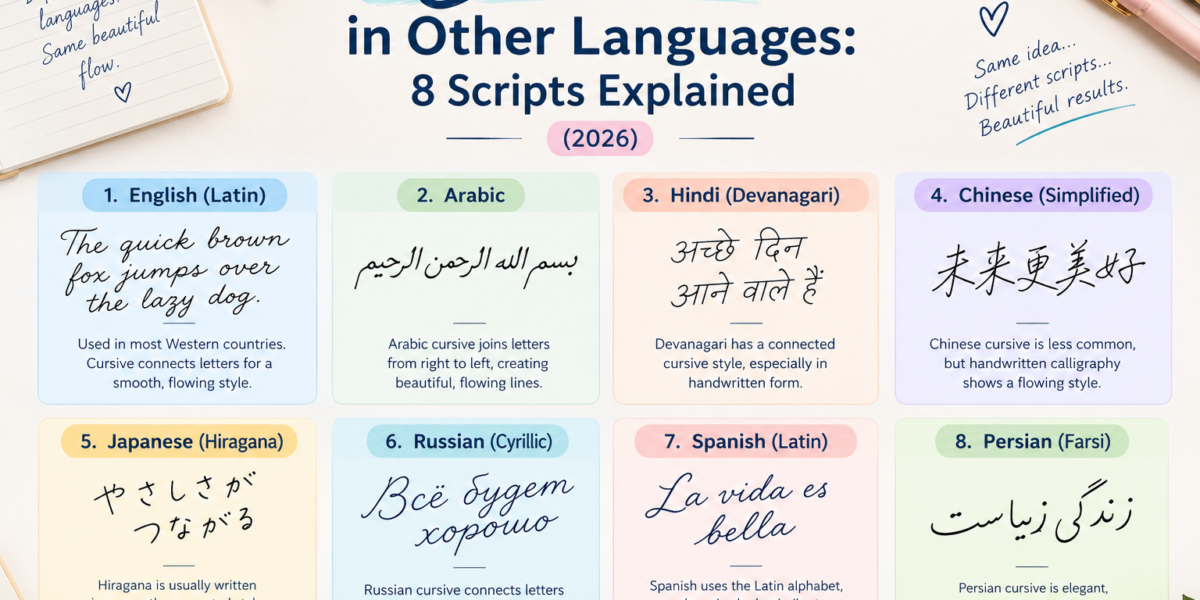
Do other languages have cursive? Yes, but “cursive” means different things depending on the writing system. In some scripts, cursive is a faster handwritten form of the printed letters. In others, letters are joined even in print. And some writing systems have running styles that look nothing like Western joined-up writing. This guide explains cursive in other languages across 8 major scripts, and what a copy-and-paste generator can and cannot do with each one.
If you are new to the topic, start with what cursive writing is. For the state of cursive in American classrooms, see is cursive taught in schools.
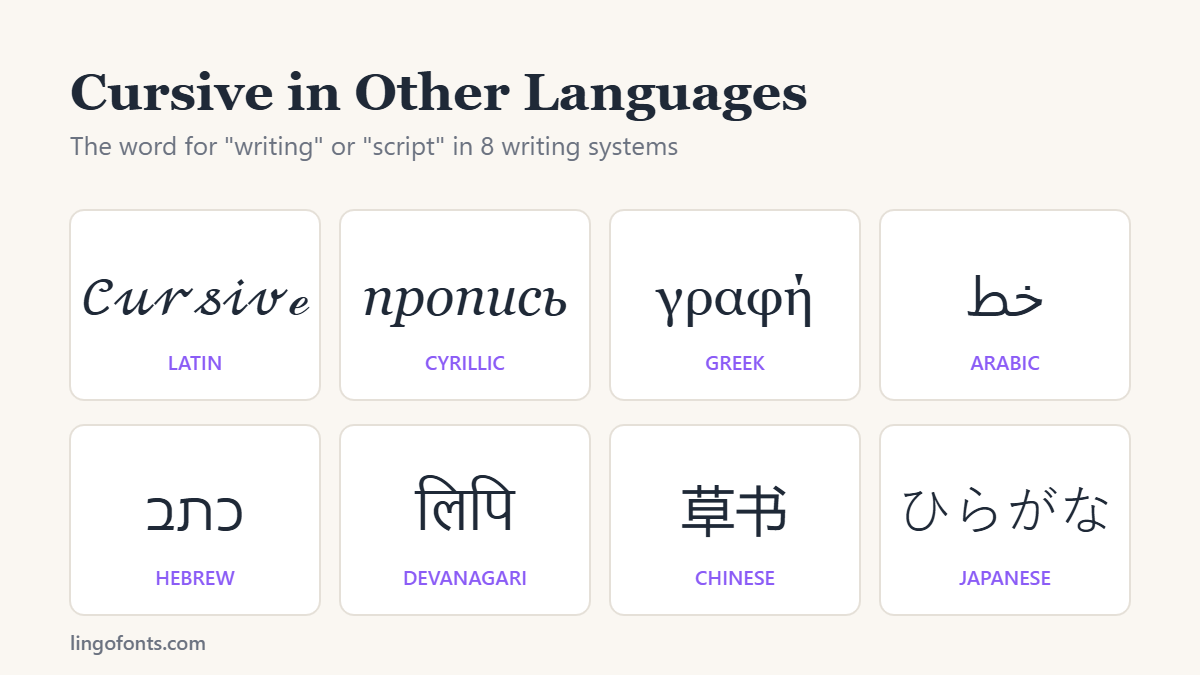
Cursive in Other Languages: Quick Comparison
| Script | Main languages | Joined in print? | Handwritten cursive | Unicode generator support |
|---|---|---|---|---|
| Latin | English, French, German, Spanish, Polish, Portuguese | No | Yes, each country has its own school model | Full (script, bold script, italic) |
| Cyrillic | Russian, Ukrainian, Bulgarian, Serbian | No | Yes, and several letters change shape | None |
| Greek | Greek | No | Yes, informally joined | Partial (bold and italic only) |
| Arabic | Arabic, Persian, Urdu | Yes, always | Built into the script | None needed; joining is automatic |
| Hebrew | Hebrew, Yiddish | No | A separate cursive alphabet, mostly unjoined | None |
| Devanagari | Hindi, Marathi, Nepali | A headline links letters | Not cursive in the Latin sense | None |
| Chinese | Mandarin, Cantonese | No | Running script and grass script | None |
| Japanese | Japanese | No | Hiragana itself grew out of cursive | None |
Latin Alphabet: Every Country Teaches Its Own Cursive
English speakers often assume cursive is one fixed alphabet. Look at cursive in other languages that use the Latin alphabet, though, and you find that each country teaches its own school model, and letter shapes differ noticeably from one to the next.
- France: children learn écriture cursive from the first years of school, traditionally on Seyès paper, a ruled grid that guides letter height.
- Germany: schools have used several models, including the Lateinische Ausgangsschrift (1953), the East German Schulausgangsschrift (1968), the Vereinfachte Ausgangsschrift, and the print-based Grundschrift (2011). Before these came Kurrent and Sütterlin, a style introduced in Prussian schools in 1915 and abolished by decree in 1941.
- Poland, Spain, Portugal, Italy: joined handwriting remains a normal part of early schooling, with diacritics such as ą, ł, ñ, and ç written into the letter flow.
Latin is also the only script Unicode covers properly. The Mathematical Alphanumeric Symbols block includes full script and bold script alphabets, which is how the Cursive Generator turns “Cursive” into 𝒞𝓊𝓇𝓈𝒾𝓋ℯ.
The catch for European languages is accents. Unicode has no styled versions of accented letters, so they stay plain. “Café” becomes 𝒞𝒶𝒻é and the Polish city Łódź becomes Łó𝒹ź, with the accented letters in a different style from the rest. If your language uses many diacritics, test a full sentence before using styled text in a bio or name.
Cyrillic: Russian Cursive Changes the Letter Shapes
Russian is the example most learners meet first when they explore cursive in other languages. Russian schools teach joined handwriting from first grade, and Russian cursive is famously hard for learners to read because several letters look like different Latin letters:
| Cursive looks like | Note | |
|---|---|---|
| т | m | The most common source of confusion |
| и | u | Not the Latin n |
| п | n | Easily mistaken for и |
| д | g | Often written with a descender |
Italic Cyrillic typefaces follow these handwritten forms, which is why italic Russian text can look like a different alphabet. Serbian and Macedonian go further: their italic forms of б, г, д, п, and т differ from the Russian ones, and well-made fonts switch shapes based on the text language.
There is no styled Cyrillic alphabet in Unicode, so a copy-and-paste generator cannot produce real Russian cursive. To get the cursive look, use italic formatting or a handwriting font in an app that supports it. Our overview of the multilingual cursive generator covers which tools work for each language.
Greek: Joined Handwriting, Partial Unicode Support
Everyday Greek handwriting is usually joined, much like Latin cursive, and uses the final form ς for sigma at the end of a word. Greek is the one non-Latin script with some styled Unicode letters, because mathematicians use Greek symbols. Bold, italic, and bold italic Greek exist:
| Style | Sample (“Γεια σου”, hello) |
|---|---|
| Plain | Γεια σου |
| Math italic | 𝛤𝜀𝜄𝛼 𝜎𝜊𝜐 |
| Math bold italic | 𝜞𝜺𝜾𝜶 𝝈𝝄𝝊 |
There is no Greek script or calligraphy style, so a true flowing Greek hand still needs a font rather than Unicode characters. Remember that screen readers may read these math letters by their symbol names.
Arabic: Cursive by Design
Arabic is the clearest answer to “do other languages have cursive”. It is cursive in print as well as handwriting: letters join within a word, and most letters change shape depending on their position. The letter beh, for example, has four forms:
| Isolated | Initial | Medial | Final |
|---|---|---|---|
| ﺏ | ﺑ | ﺒ | ﺐ |
Six letters (ا د ذ ر ز و) never connect to the letter after them, which is why Arabic words often appear in separate connected pieces. Arabic also has distinct calligraphic styles:
- Naskh: the standard style for books and printed text.
- Ruqʿah: compact everyday handwriting.
- Thuluth: large, decorative lettering used in inscriptions.
- Diwani: an ornate style that developed in the Ottoman court.
- Kufic: an angular style used in early manuscripts.
- Nastaliq: the sloping style used for Persian and Urdu.
In digital text, Arabic cursive needs no generator. Each Arabic cursive letter is stored once, and the font and text renderer choose the correct joined form automatically, as described in the W3C’s Arabic and Persian layout requirements. Unicode does include “presentation form” characters like those in the table above, but they exist for compatibility. Pasting them as text breaks joining, search, and copy-paste, so avoid tools that output them.
For Urdu writers, the main issue is the font, not cursive. Many phones and apps default to Naskh-style fonts, so Urdu that should appear in Nastaliq can look flat. Choosing a Nastaliq font such as Noto Nastaliq Urdu fixes this where the app allows it.
Hebrew: A Separate Cursive Alphabet
Hebrew is a reminder that cursive in other languages does not always mean joined letters. Israelis write by hand in Hebrew cursive, a script whose letter shapes differ sharply from the square print letters. Despite the name, Hebrew cursive letters are mostly written separately rather than joined. Unicode uses the same characters for print and cursive Hebrew, so the cursive look comes only from a handwriting font.
Devanagari: Connected, But Not Cursive
Hindi and other languages written in Devanagari look connected because a horizontal headline, the shirorekha, runs across the top of each word. That line links the letters visually, but the letters themselves are written as separate shapes, and consonants combine into conjuncts by rule, not by speed. So Devanagari is not cursive in the Latin sense, even though it can look joined.
Chinese and Japanese: Running Script and Grass Script
In East Asia, cursive in other languages takes a different form entirely. Chinese calligraphy recognizes several script styles. Two of them are cursive in spirit: running script (行书, xíngshū), a semi-cursive style used in everyday handwriting, and grass script (草书, cǎoshū), which abbreviates strokes so heavily that untrained readers struggle with it.
Japanese uses the same running and grass styles for kanji. Its hiragana syllabary actually grew out of grass-script versions of Chinese characters used for their sounds. In other words, part of the Japanese writing system is cursive in origin. As with every script in this section, Unicode stores the character and the font supplies the style.
What a Cursive Generator Can and Cannot Do in Other Languages
Copy-and-paste cursive works by swapping plain letters for styled Unicode lookalikes. That makes support for cursive in other languages uneven:
- Latin: full support, except accented letters stay plain.
- Greek: bold and italic only.
- Arabic: already cursive; choose a good font instead.
- Cyrillic, Hebrew, Devanagari, Chinese, Japanese: no styled letters exist, so use fonts or app formatting.
For the difference between the two approaches, read Unicode text vs. real fonts. If styled letters show as boxes for some readers, this guide to missing characters explains why. And if you are choosing between flowing styles for a Latin-script project, compare cursive vs. calligraphy.
Ready to try it? Type your text in the Cursive Generator to see every Latin cursive style at once, and come back to this guide to cursive in other languages when your text goes beyond English.
Frequently Asked Questions
Do other languages have cursive?
Yes. Latin, Cyrillic, and Greek have handwritten cursive forms, Arabic is cursive even in print, Hebrew has a separate cursive alphabet, and Chinese and Japanese have running and grass scripts. The details differ a lot between writing systems.
Is Arabic a cursive language?
Yes. Arabic letters join within a word in both print and handwriting, and most letters change shape depending on their position. Six letters never connect to the letter that follows them.
Does Russian have cursive?
Yes. Russian schools teach joined handwriting, and several cursive letters look like different Latin letters: т looks like m, и like u, п like n, and д like g.
Is Chinese written in cursive?
Chinese has two cursive-style calligraphy scripts: running script, a semi-cursive used in everyday handwriting, and grass script, a heavily abbreviated style. Standard print uses regular script.
Can I generate cursive text in any language?
No. Unicode only has styled script letters for the basic Latin alphabet, plus bold and italic Greek. Accented Latin letters stay plain, and other scripts need a font or app formatting to look cursive.