The cursive alphabet is the set of 26 joined-up letters, in uppercase and lowercase, used for flowing handwriting. Below you will find every cursive letter from A to Z to copy and paste, the stroke groups teachers use to learn them, the letters most people find hardest, and a simple practice routine. To turn whole words or names into cursive text instantly, use our free Cursive Text Generator.
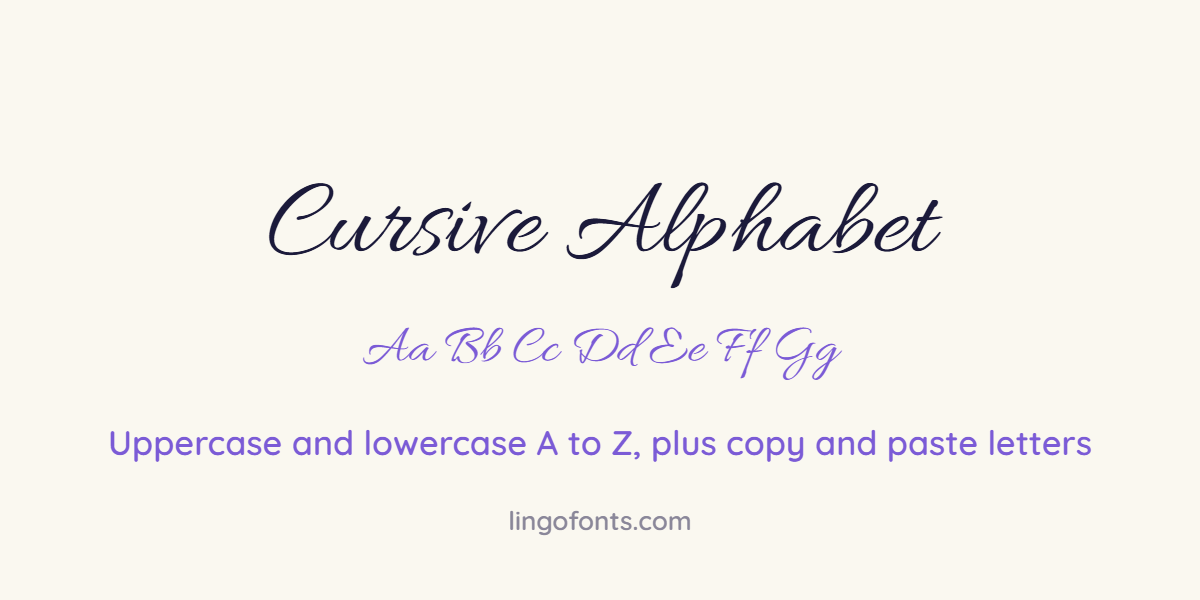
Cursive Alphabet to Copy and Paste
These are Unicode script letters, so they paste as text into Instagram, TikTok, Discord, WhatsApp and most apps. The bold set is heavier and renders more evenly on phones.
Uppercase: 𝒜 ℬ 𝒞 𝒟 ℰ ℱ 𝒢 ℋ ℐ 𝒥 𝒦 ℒ ℳ 𝒩 𝒪 𝒫 𝒬 ℛ 𝒮 𝒯 𝒰 𝒱 𝒲 𝒳 𝒴 𝒵
Lowercase: 𝒶 𝒷 𝒸 𝒹 ℯ 𝒻 ℊ 𝒽 𝒾 𝒿 𝓀 𝓁 𝓂 𝓃 ℴ 𝓅 𝓆 𝓇 𝓈 𝓉 𝓊 𝓋 𝓌 𝓍 𝓎 𝓏
Bold uppercase: 𝓐 𝓑 𝓒 𝓓 𝓔 𝓕 𝓖 𝓗 𝓘 𝓙 𝓚 𝓛 𝓜 𝓝 𝓞 𝓟 𝓠 𝓡 𝓢 𝓣 𝓤 𝓥 𝓦 𝓧 𝓨 𝓩
Bold lowercase: 𝓪 𝓫 𝓬 𝓭 𝓮 𝓯 𝓰 𝓱 𝓲 𝓳 𝓴 𝓵 𝓶 𝓷 𝓸 𝓹 𝓺 𝓻 𝓼 𝓽 𝓾 𝓿 𝔀 𝔁 𝔂 𝔃
Cursive Capital Letters A to Z
Capital cursive letters are the ones people forget first, because many of them look nothing like their print versions. Use this table as a quick reference.
| Letter | Cursive capital | Bold cursive capital | Cursive lowercase |
|---|---|---|---|
| A | 𝒜 | 𝓐 | 𝒶 |
| B | ℬ | 𝓑 | 𝒷 |
| C | 𝒞 | 𝓒 | 𝒸 |
| D | 𝒟 | 𝓓 | 𝒹 |
| E | ℰ | 𝓔 | ℯ |
| F | ℱ | 𝓕 | 𝒻 |
| G | 𝒢 | 𝓖 | ℊ |
| H | ℋ | 𝓗 | 𝒽 |
| I | ℐ | 𝓘 | 𝒾 |
| J | 𝒥 | 𝓙 | 𝒿 |
| K | 𝒦 | 𝓚 | 𝓀 |
| L | ℒ | 𝓛 | 𝓁 |
| M | ℳ | 𝓜 | 𝓂 |
| N | 𝒩 | 𝓝 | 𝓃 |
| O | 𝒪 | 𝓞 | ℴ |
| P | 𝒫 | 𝓟 | 𝓅 |
| Q | 𝒬 | 𝓠 | 𝓆 |
| R | ℛ | 𝓡 | 𝓇 |
| S | 𝒮 | 𝓢 | 𝓈 |
| T | 𝒯 | 𝓣 | 𝓉 |
| U | 𝒰 | 𝓤 | 𝓊 |
| V | 𝒱 | 𝓥 | 𝓋 |
| W | 𝒲 | 𝓦 | 𝓌 |
| X | 𝒳 | 𝓧 | 𝓍 |
| Y | 𝒴 | 𝓨 | 𝓎 |
| Z | 𝒵 | 𝓩 | 𝓏 |
Eleven regular script letters (ℬ ℰ ℱ ℋ ℐ ℒ ℳ ℛ ℯ ℊ ℴ) live in an older part of the Unicode Letterlike Symbols block rather than with the other script letters, so on some phones they look slightly different in size or weight. The bold cursive set has no such gaps. If letters show as boxes, see why fancy text looks like boxes.
Cursive Lowercase Letters, Grouped by First Stroke
Handwriting programs rarely teach the alphabet in A to Z order. They group letters by the stroke that starts them, so each new letter reuses a movement you already know. A common grouping looks like this:
| Group | Starting stroke | Letters |
|---|---|---|
| Undercurve letters | A curve that sweeps up from the baseline | i, t, u, w, e, l, b, h, f, k, r, s, j, p |
| Downcurve letters | A curve that starts at the top and moves left and down, like a c | a, d, g, o, c, q |
| Overcurve letters | A hump that rises over the top, like the start of an n | n, m, v, y, x, z |
Learn one group at a time. Once the starting stroke is automatic, every letter in that group takes only a few practice lines.
The Hardest Cursive Letters (and How to Get Them Right)
- Capital Q: often looks like the number 2. Start with a loop at the top and finish with a small tail through the baseline.
- Capital G: the loop sits at the top and the stem drops below it, which feels backwards if you know print G.
- Lowercase r: has a small shoulder after the upstroke. Keep it short or it reads as an i.
- Lowercase s: closes with a small point before joining the next letter. Without the point it looks like an e.
- Lowercase z: many styles use a looped descender that drops below the line.
- Lowercase f: has both an upper loop and a lower loop, so it takes up three line spaces.
How to Write in Cursive: A 15-Minute Practice Routine
- Use lined paper and tilt it slightly, about the same angle as your writing slant.
- Warm up with a row of connected loops (eeee) and humps (nnnn) for one minute.
- Practice one stroke group from the table above: five letters, one line each.
- Join pairs of letters that appear often in English, such as th, in, an, er and on.
- Write five short words that use today’s letters, then one full sentence.
- Finish by writing your name in cursive three times, which is the cursive most adults still use when they sign.
Keep sessions short and daily. If you want background on why cursive is joined and where it came from, read what cursive writing is, and see which US states still require cursive in schools.
Cursive Fonts for Typing and Design
For invitations, posters and logos, use a real cursive font instead of Unicode letters. Our cursive generator previews your words in 30 free Google Fonts, including Sacramento, Allura, Pinyon Script, Pacifico, Satisfy and Italianno, and lets you download a transparent PNG. Script fonts and handwritten fonts suit different jobs:
- Formal script (Pinyon Script, Petit Formal Script, Italianno): wedding stationery and certificates.
- Casual script (Pacifico, Satisfy, Yellowtail, Cookie): logos, social graphics and labels.
- Handwritten print (Caveat, Kalam, Indie Flower): notes, planners and friendly captions.
For elegant broad-pen letters rather than everyday joined writing, compare the calligraphy alphabet. Writing in another language? See cursive in other languages.
Cursive Letters and Accessibility
Unicode cursive letters are read by screen readers as “mathematical script capital C” and so on, or skipped entirely, as WebAIM explains. Use them for a name or short phrase, and keep important information in plain text.
Frequently Asked Questions
How many letters are in the cursive alphabet?
The cursive alphabet has the same 26 letters as the print alphabet, each with an uppercase and a lowercase form, so 52 letter shapes in total.
What is the hardest cursive letter to write?
Many people find capital Q, capital G, lowercase r and lowercase z the hardest, because their cursive shapes differ most from print.
Can I copy and paste cursive letters?
Yes. The cursive letters on this page are Unicode characters, so they paste into Instagram, TikTok, Discord and most apps. Use the Cursive Text Generator to convert whole words.
What order should I learn cursive letters in?
Learn them by starting stroke rather than A to Z: undercurve letters such as i, t, u and w first, then downcurve letters such as a, d, g and o, then overcurve letters such as n, m and v.
Why do some cursive letters look different when I paste them?
Eleven script letters come from an older Unicode block, so some phones draw them in a different weight. The bold cursive set avoids this.
Is the cursive alphabet the same in every school?
No. Programs such as Zaner-Bloser and D’Nealian teach slightly different letter shapes, especially for capitals, but every style connects letters with joining strokes.