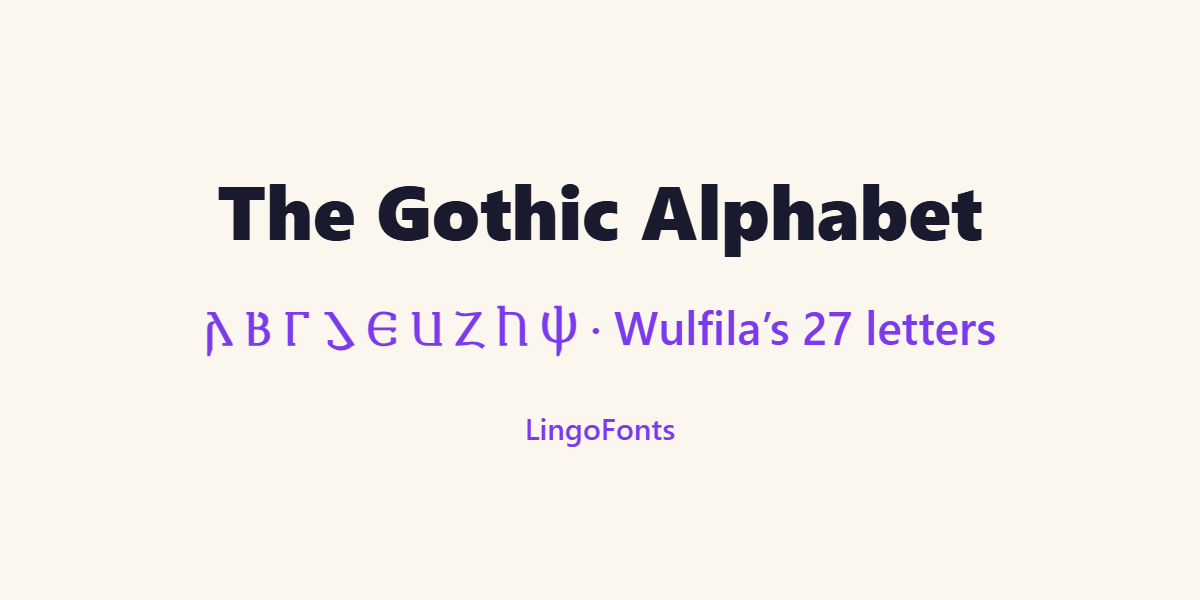
The Gothic alphabet is the 27-letter script that Bishop Wulfila (also spelled Ulfilas) created in the 4th century AD to write the Gothic language, mainly for his translation of the Bible. It looks like 𐌲𐌿𐍄𐌹𐍃𐌺𐌰 (“Gothic”), not like the spiky blackletter “Gothic” fonts. Below you will find every letter with its Unicode name, sound and number value, ready to copy. If you were looking for blackletter instead, use the gothic text generator.
Gothic Alphabet vs. “Gothic” Fonts
The two share a name and nothing else. Britannica notes that the Gothic alphabet should not be confused with “Gothic script,” a way of writing the Latin alphabet. Blackletter (Fraktur, Textura, Old English) is a medieval style of Latin handwriting that later became a typeface family; Wulfila’s alphabet is a separate writing system for a separate language. Our blackletter font guide covers the first; this page covers the second.
| Dates from | Writes | Looks like | |
|---|---|---|---|
| Wulfila’s Gothic alphabet | 4th century | Gothic (an East Germanic language) | 𐌲𐌿𐍄𐌹𐍃𐌺𐌰 |
| Blackletter (“Gothic” fonts) | 12th century onward | Latin alphabet, many languages | 𝔊𝔬𝔱𝔥𝔦𝔠 |
All 27 Gothic Letters to Copy
Each letter has a traditional name (most refer to a word starting with that sound) and a number value, because the Goths, like the Greeks, used letters as numerals. Two letters, for 90 and 900, were used only as numbers. The Unicode names below come from the Unicode Gothic code chart (U+10330 to U+1034A).
| Letter | Name | Sound | Value | Code point | Unicode name |
|---|---|---|---|---|---|
| 𐌰 | ahsa | a | 1 | U+10330 | GOTHIC LETTER AHSA |
| 𐌱 | bairkan | b | 2 | U+10331 | GOTHIC LETTER BAIRKAN |
| 𐌲 | giba | g | 3 | U+10332 | GOTHIC LETTER GIBA |
| 𐌳 | dags | d | 4 | U+10333 | GOTHIC LETTER DAGS |
| 𐌴 | aiƕus | e | 5 | U+10334 | GOTHIC LETTER AIHVUS |
| 𐌵 | qairþa | q | 6 | U+10335 | GOTHIC LETTER QAIRTHRA |
| 𐌶 | iuja | z | 7 | U+10336 | GOTHIC LETTER IUJA |
| 𐌷 | hagl | h | 8 | U+10337 | GOTHIC LETTER HAGL |
| 𐌸 | þiuþ | þ (th) | 9 | U+10338 | GOTHIC LETTER THIUTH |
| 𐌹 | eis | i | 10 | U+10339 | GOTHIC LETTER EIS |
| 𐌺 | kusma | k | 20 | U+1033A | GOTHIC LETTER KUSMA |
| 𐌻 | lagus | l | 30 | U+1033B | GOTHIC LETTER LAGUS |
| 𐌼 | manna | m | 40 | U+1033C | GOTHIC LETTER MANNA |
| 𐌽 | nauþs | n | 50 | U+1033D | GOTHIC LETTER NAUTHS |
| 𐌾 | jer | j | 60 | U+1033E | GOTHIC LETTER JER |
| 𐌿 | urus | u | 70 | U+1033F | GOTHIC LETTER URUS |
| 𐍀 | pairþa | p | 80 | U+10340 | GOTHIC LETTER PAIRTHRA |
| 𐍁 | — | (number only) | 90 | U+10341 | GOTHIC LETTER NINETY |
| 𐍂 | raida | r | 100 | U+10342 | GOTHIC LETTER RAIDA |
| 𐍃 | sauil | s | 200 | U+10343 | GOTHIC LETTER SAUIL |
| 𐍄 | teiws | t | 300 | U+10344 | GOTHIC LETTER TEIWS |
| 𐍅 | winja | w | 400 | U+10345 | GOTHIC LETTER WINJA |
| 𐍆 | faihu | f | 500 | U+10346 | GOTHIC LETTER FAIHU |
| 𐍇 | iggws | x (ch) | 600 | U+10347 | GOTHIC LETTER IGGWS |
| 𐍈 | ƕair | ƕ (hw) | 700 | U+10348 | GOTHIC LETTER HWAIR |
| 𐍉 | oþal | o | 800 | U+10349 | GOTHIC LETTER OTHAL |
| 𐍊 | — | (number only) | 900 | U+1034A | GOTHIC LETTER NINE HUNDRED |
Copy the full alphabet in order: 𐌰 𐌱 𐌲 𐌳 𐌴 𐌵 𐌶 𐌷 𐌸 𐌹 𐌺 𐌻 𐌼 𐌽 𐌾 𐌿 𐍀 𐍁 𐍂 𐍃 𐍄 𐍅 𐍆 𐍇 𐍈 𐍉 𐍊.
Where the Letters Come From
Most Gothic letters are adapted from Greek uncial writing, a few from Latin, and about two from runes or invented outright. Britannica gives the split as 19 or 20 from Greek, 5 or 6 from Latin, and 2 from runic script or independent invention. You can see it in the shapes: 𐌲 (g) follows Greek Γ, 𐍂 (r) follows Latin R, and 𐌿 (u) and 𐍉 (o) echo runes. The script has no capital and small letter forms: every letter has one shape.
The Codex Argenteus: The “Silver Bible”
Wulfila’s own manuscripts are lost, but copies from the 5th and 6th centuries survive. The most important is the Codex Argenteus, kept at Uppsala in Sweden, written in silver and gold ink on purple-red parchment. It preserves large parts of the four Gospels and is one of the main reasons we know how Gothic was written and spoken. Manuscripts run words together without spaces; a middle dot or colon often separates phrases.
How to Type and Use Gothic Letters
- Copy and paste from the table above. There is no Gothic keyboard on phones.
- Fonts: modern Windows, macOS, iOS and Android display Gothic characters, but some older devices show boxes. Free fonts such as Noto Sans Gothic cover the whole block.
- Writing English in Gothic letters: you can transliterate sound by sound, for example 𐌻𐌿𐌽𐌰 for “luna”. This is a fun cipher, not real Gothic language.
- Numbers: to show a letter is a number, scribes put a dot on each side or a line above it, so ·𐌹𐌱· means 12 (10 + 2).
For decorative “gothic” names on Instagram or Discord, the gothic text generator is usually what people want, since blackletter Unicode characters read as Latin letters. Wulfila’s letters work best for history projects, tattoos researched with care, fantasy worldbuilding and puzzle games.
Related Tools and Guides
- Gothic Text Generator: blackletter text to copy and paste
- Blackletter Font Guide
- Aesthetic Symbols to Copy and Paste
Frequently Asked Questions
What is the Gothic alphabet?
It is the 27-letter script created by Bishop Wulfila in the 4th century AD to write the Gothic language, used mainly for his Bible translation.
How many letters are in the Gothic alphabet?
27. Twenty-five stand for sounds, and two (for 90 and 900) were used only as numbers.
Is the Gothic alphabet the same as gothic font?
No. Gothic or blackletter fonts are a style of the Latin alphabet. Wulfila’s Gothic alphabet is a separate writing system.
Who created the Gothic alphabet?
Bishop Wulfila, also called Ulfilas, who lived from about 311 to 383 AD.
What is the Codex Argenteus?
The “Silver Bible”, a 6th-century copy of Wulfila’s Gospels kept at Uppsala in Sweden, written in silver and gold on purple parchment.
Can I copy Gothic letters?
Yes. They are Unicode characters (U+10330 to U+1034A) and paste into most modern apps.