Backwards letters are characters that look like normal letters flipped left to right, such as Ǝ, Я and ɘ. Unicode has no official backwards alphabet, so every mirrored letter you can copy is borrowed from another writing system or a phonetic alphabet that happens to contain the right shape. Below is the full mirrored alphabet A to Z, plus reversed numbers and punctuation, with each character’s code point so you know exactly what you are pasting. To flip whole words automatically, use the free Mirror Text Generator.
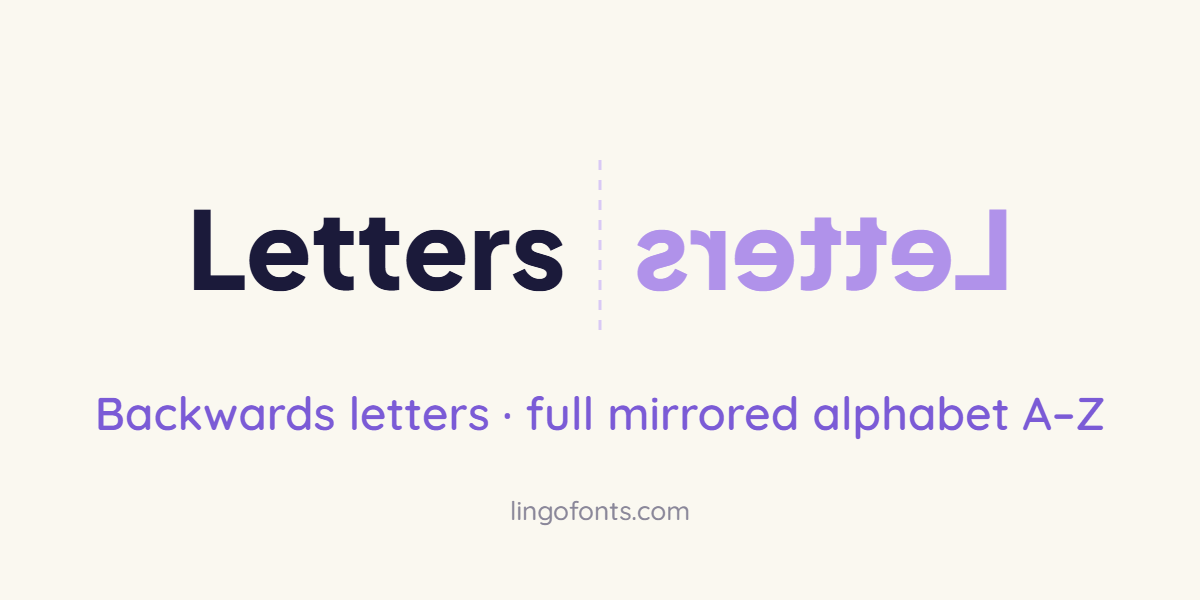
Backwards Alphabet to Copy and Paste
Select and copy either line. These are the same characters our generator uses, so the results match.
Lowercase: ɒ d ɔ b ɘ ʇ ϱ ʜ i ᒑ ʞ l m n o q p ɿ ꙅ ƚ u v w x γ ꙃ
Uppercase: A ᙠ Ɔ ᗡ Ǝ ᖷ ᘓ H I ᒐ ꓘ ⅃ M И O ꟼ Ϙ Я Ꙅ T U V W X Y Ƹ
Numbers:   0 1 ς Ɛ ᔭ ट მ Ⲋ 8 ୧
Backwards Lowercase Letters
Lowercase letters not listed here (i, l, m, n, o, u, v, w and x) are symmetrical enough that they look the same in a mirror, so they stay unchanged.
| Letter | Backwards | Code point | Where the character comes from |
|---|---|---|---|
| a | ɒ | U+0252 | Latin turned alpha (IPA) |
| b | d | U+0064 | Plain Latin d |
| c | ɔ | U+0254 | Latin open o (IPA) |
| d | b | U+0062 | Plain Latin b |
| e | ɘ | U+0258 | Latin reversed e (IPA) |
| f | ʇ | U+0287 | Latin turned t |
| g | ϱ | U+03F1 | Greek rho symbol |
| h | ʜ | U+029C | Latin small capital H (no reversed h exists) |
| j | ᒑ | U+1491 | Canadian Syllabics |
| k | ʞ | U+029E | Latin turned k |
| p | q | U+0071 | Plain Latin q |
| q | p | U+0070 | Plain Latin p |
| r | ɿ | U+027F | Latin reversed r with fishhook (IPA) |
| s | ꙅ | U+A645 | Cyrillic reversed dze |
| t | ƚ | U+019A | Latin l with bar |
| y | γ | U+03B3 | Greek gamma (no reversed y exists) |
| z | ꙃ | U+A643 | Cyrillic dzelo |
Four of these are swaps rather than special characters: a mirrored b is simply a d, and a mirrored p is a q. Two letters, h and y, have no reversed form anywhere in Unicode, so the closest symmetrical lookalikes (ʜ and γ) are used instead.
Backwards Capital Letters
Capitals A, H, I, M, O, T, U, V, W, X and Y are already symmetrical left to right, so they need no replacement.
| Letter | Backwards | Code point | Where the character comes from |
|---|---|---|---|
| B | ᙠ | U+1660 | Canadian Syllabics (Carrier) |
| C | Ɔ | U+0186 | Latin capital open O |
| D | ᗡ | U+15E1 | Canadian Syllabics (Carrier) |
| E | Ǝ | U+018E | Latin capital reversed E |
| F | ᖷ | U+15B7 | Canadian Syllabics (Blackfoot) |
| G | ᘓ | U+1613 | Canadian Syllabics (Carrier) |
| J | ᒐ | U+1490 | Canadian Syllabics |
| K | ꓘ | U+A4D8 | Lisu letter KHA |
| L | ⅃ | U+2143 | Reversed sans-serif capital L |
| N | И | U+0418 | Cyrillic capital I |
| P | ꟼ | U+A7FC | Latin epigraphic reversed P |
| Q | Ϙ | U+03D8 | Greek archaic koppa |
| R | Я | U+042F | Cyrillic capital Ya |
| S | Ꙅ | U+A644 | Cyrillic capital reversed dze |
| Z | Ƹ | U+01B8 | Latin capital reversed ezh |
Backwards Numbers and Punctuation
The digits 0, 1 and 8 read the same mirrored. The rest use lookalike shapes from other scripts.
| Character | Backwards | Code point | Where the character comes from |
|---|---|---|---|
| 2 | ς | U+03C2 | Greek final sigma |
| 3 | Ɛ | U+0190 | Latin capital open E |
| 4 | ᔭ | U+152D | Canadian Syllabics |
| 5 | ट | U+091F | Devanagari letter TTA |
| 6 | მ | U+10DB | Georgian letter MAN |
| 7 | Ⲋ | U+2C8A | Coptic capital SOU |
| 9 | ୧ | U+0B67 | Odia digit one |
| ? | ⸮ | U+2E2E | Reversed question mark |
| ; | ⁏ | U+204F | Reversed semicolon |
Why Unicode Has No Real Backwards Alphabet
The Unicode Standard encodes characters, not visual effects. A mirrored A is still the letter A, so Unicode does not give it a separate code point, in the same way it has no “italic A” for ordinary text. Flipping text is treated as a job for fonts, graphics software or CSS, not for the character set.
Backwards letters only exist as copyable text because other writing systems contain shapes that look like flipped Latin letters. The tables above draw on seven different sources:
- The International Phonetic Alphabet: ɘ, ɔ and ɿ are phonetic symbols. In the IPA, ɘ represents a close-mid central vowel and ɔ an open-mid back rounded vowel.
- Cyrillic: Я (Ya) and И (I) are ordinary Russian letters. Ꙅ and ꙅ (reversed dze) come from early Cyrillic manuscripts.
- Canadian Aboriginal Syllabics: ᗡ, ᙠ and ᘓ are letters used for Carrier, and ᖷ for Blackfoot. Syllabics are used to write Indigenous languages such as Cree and Inuktitut.
- Lisu: ꓘ is a letter of the Fraser alphabet used for the Lisu language.
- Latin epigraphic letters: ꟼ and its sibling ꟻ (reversed F) record reversed letters found in ancient Latin inscriptions.
- Greek, Coptic, Georgian, Devanagari and Odia: used for lookalike digits and for ϱ, γ and Ϙ.
- Letterlike symbols and punctuation: ⅃ (reversed sans-serif L), ⸮ and ⁏.
Genuinely Reversed Characters in Unicode
Most backwards letters are lookalikes, but a few code points are officially named “reversed” in the Unicode code charts. If you need one specific mirrored letter and accuracy matters, these are the closest you can get:
| Character | Code point | Official Unicode name |
|---|---|---|
| ɘ | U+0258 | Latin small letter reversed e |
| Ǝ | U+018E | Latin capital letter reversed E |
| ɿ | U+027F | Latin small letter reversed r with fishhook |
| ᴎ | U+1D0E | Latin letter small capital reversed N |
| ᴙ | U+1D19 | Latin letter small capital reversed R |
| ⅃ | U+2143 | Reversed sans-serif capital L |
| ꟻ | U+A7FB | Latin epigraphic letter reversed F |
| ꟼ | U+A7FC | Latin epigraphic letter reversed P |
| ⸮ | U+2E2E | Reversed question mark |
| ⁏ | U+204F | Reversed semicolon |
ᴎ and ᴙ are useful alternatives to the Cyrillic И and Я when you want a reversed N or R that is still a Latin letter. The reversed question mark has a history of its own: the printer Henry Denham proposed it in the 1580s as a “percontation point” to mark rhetorical questions.
Backwards E vs. the “There Exists” Symbol
Ǝ (U+018E) is easy to confuse with ∃ (U+2203), the mathematical symbol for “there exists”. They look almost identical but are different characters. Use Ǝ in names and words, and ∃ only in logic or maths, so search and copy behave as expected.
Where Backwards Letters Break
- Empty boxes: if a device has no font containing a character, it shows a box or question mark instead (often called “tofu”). Characters from less common blocks, such as Canadian Syllabics, Lisu and the Latin epigraphic letters, are the most likely to fail on older phones. Test your text on the device your audience uses.
- Search and hashtags: a backwards word is made of different characters, so search engines and in-app search will not match it to the normal word. Keep keywords you want found in plain text.
- Usernames and game names: many platforms only allow basic Latin letters in handles, so mirrored characters may be rejected or stripped.
- Spell check and translation: Я and И are real Cyrillic letters, so autocorrect and translation tools may treat your text as Russian.
Backwards Letters and Accessibility
Screen readers read characters by what they are, not how they look. A word written as ƎЯIM may be read out letter by letter, announced as foreign characters, or skipped, so people using assistive technology will not hear the word you meant. WebAIM’s guide to screen readers explains how these tools interpret text. Use backwards letters for short decorative touches, and keep names, links and important information in plain text.
Backwards Letters vs. Mirror Text vs. Upside Down Text
Backwards letters are the individual characters. Mirror text uses them and also reverses the letter order, so a whole word reads correctly in a mirror. Upside down text rotates letters 180 degrees with a different character set. For step-by-step methods in Word, Google Docs, Canva and Cricut, see how to mirror text. For rotated text, try the Upside Down Text Generator.
How to Type Backwards Letters
- Any device: copy from the tables above, or type a word into the Mirror Text Generator and copy the result.
- Windows: in Microsoft Word, type the code point without “U+” (for example 018E) and press Alt+X to turn it into Ǝ.
- Mac: open the Character Viewer with Control+Command+Space and search for the character name, such as “reversed e”.
- Linux (GTK apps): press Ctrl+Shift+U, type the code point and press Enter.
- HTML: use a numeric entity, for example Ǝ for Ǝ.
For more decorative characters to pair with these, browse our aesthetic symbols list or the copy and paste fonts guide. For spooky Old English lettering, try the gothic text generator.
Frequently Asked Questions
Is there a backwards alphabet in Unicode?
No. Unicode encodes characters, not visual effects, so there is no official mirrored alphabet. Backwards letters are borrowed from other scripts, such as Cyrillic, the IPA and Canadian Syllabics, plus a few code points officially named reversed.
What is the backwards R called?
The usual backwards R is Я, the Cyrillic capital letter Ya (U+042F). A Latin alternative is ᴙ (U+1D19), the small capital reversed R.
How do I type a backwards E?
Copy Ǝ (U+018E) or ɘ (U+0258). In Word on Windows, type 018E and press Alt+X. On a Mac, search for reversed e in the Character Viewer.
Why do my backwards letters show as boxes?
The device has no font that contains that character. Characters from less common blocks, such as Canadian Syllabics or Lisu, fail most often. Swap in a more widely supported lookalike or keep that letter plain.
Which letters look the same backwards?
Capitals A, H, I, M, O, T, U, V, W, X and Y, lowercase i, l, m, n, o, u, v, w and x, and the digits 0, 1 and 8 are symmetrical enough to look unchanged in a mirror.
Do screen readers read backwards letters?
They read the actual characters, so mirrored words are often spelled out, read as foreign letters or skipped. Keep important words in plain text for accessibility.